11 June 2026
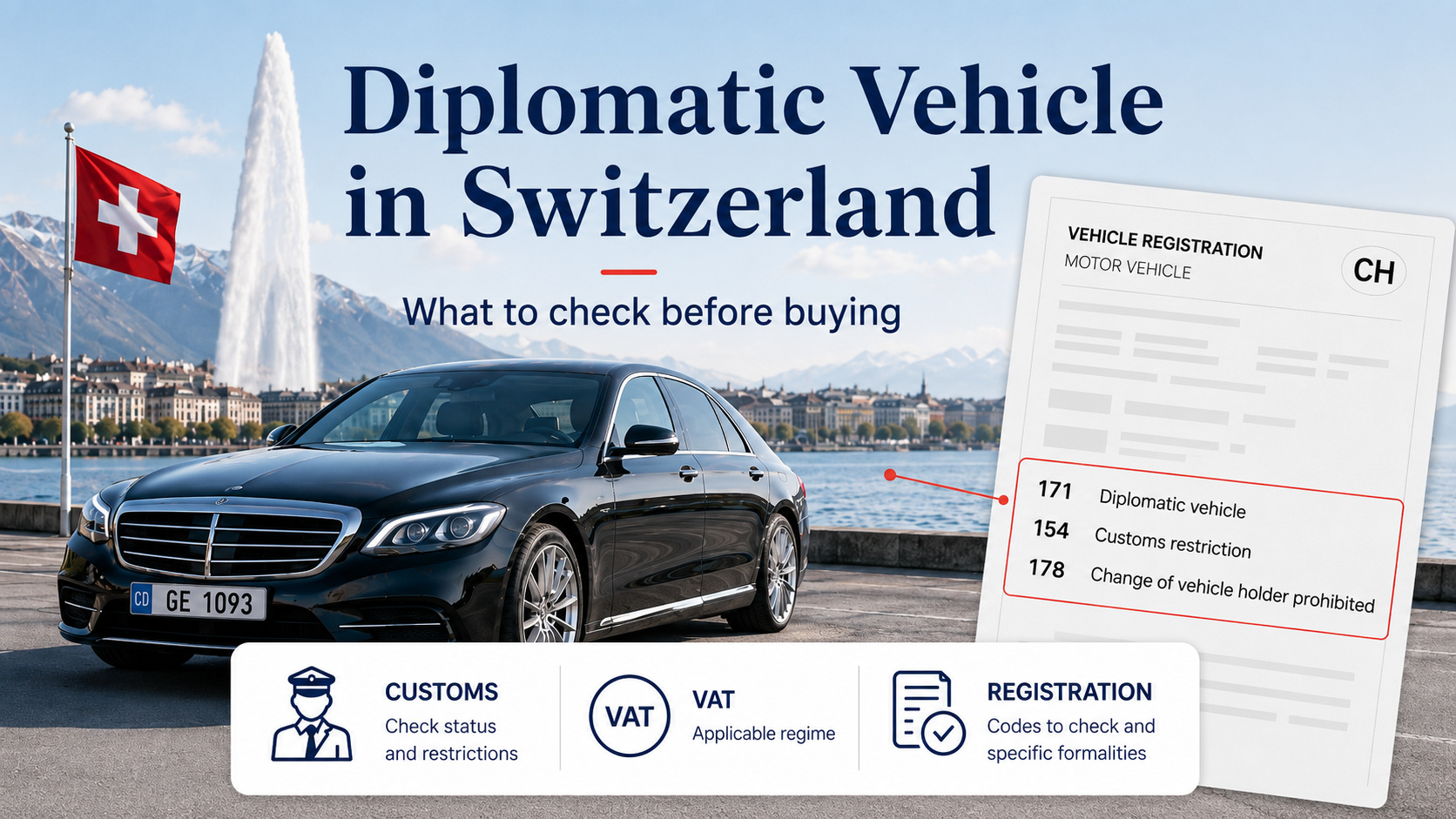
Diplomatic vehicle in Switzerland: what should you watch out for when buying or selling
Diplomatic vehicle in Switzerland: what should you watch out for when buying or selling

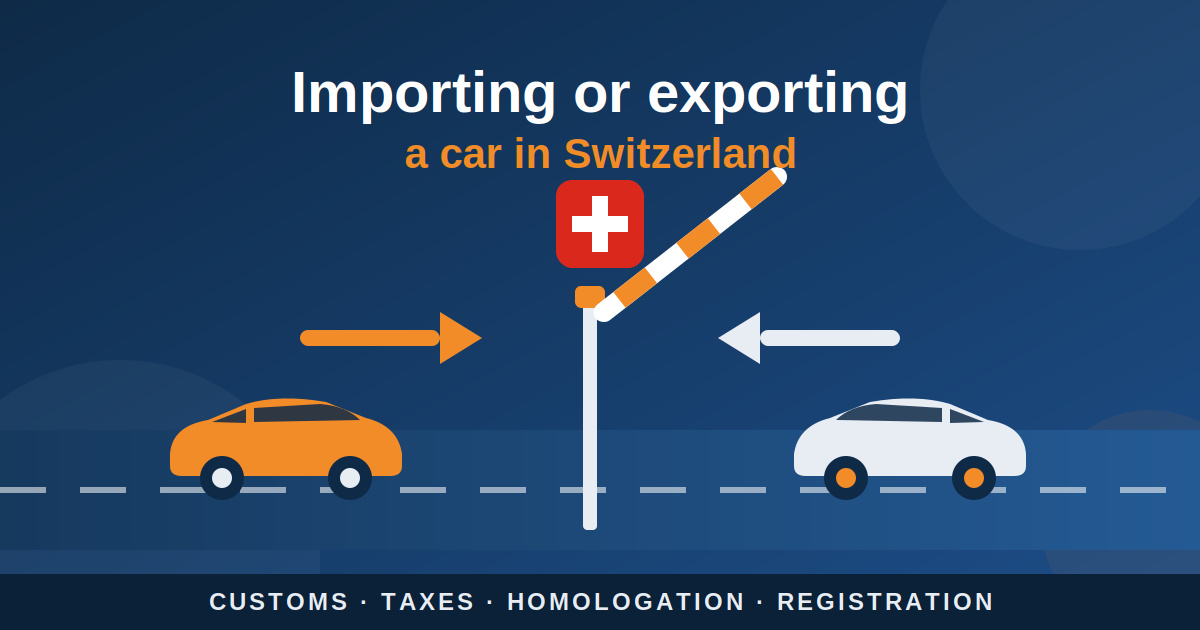
Buying a car abroad to bring it into Switzerland, or selling a Swiss vehicle to a foreign buyer: both operations are legal and common, but they involve precise customs formalities and taxes that can amount to several thousand francs. This guide covers the steps, documents and costs — in both directions across the border.
Before signing any contract abroad, make sure the vehicle can actually be registered in Switzerland. Two points are decisive.
The first is type approval. If the model has a Swiss type approval or a recognised European homologation, registration will be straightforward. Otherwise, an individual homologation is required — a lengthy and costly procedure that can run to several thousand francs.
The second is the Certificate of Conformity (COC). This document, provided by the seller or issued by the manufacturer (sometimes for a fee), certifies that the vehicle complies with European technical standards. It greatly simplifies the cantonal inspection, although it does not guarantee registration.
When buying from a foreign dealer, it is advisable to negotiate a price excluding VAT, or to have the contract stipulate that the foreign VAT will be refunded after export. When buying from a private individual, foreign VAT is generally not recoverable.
The vehicle must be declared spontaneously at a Swiss customs office open to goods traffic, during counter opening hours. The following documents must be presented:
the sales contract or invoice
the foreign vehicle registration document (even if cancelled)
the Certificate of Conformity (COC), if available
an identity document
the customs import declaration
Regarding electronic declarations, the Passar system is gradually replacing the former e-dec system, with the transition due to be completed by April 2027.
If clearance at the border is not possible, you can request a registration certificate (form 15.25) at the border post, which grants two working days to report to an inland customs office.
Practical tip: taxes are paid directly at the customs office, and not all offices accept bank cards. It is wise to carry cash.
Three main levies apply when importing a passenger car into Switzerland.
The automobile tax: 4%. This federal tax is levied on the value of the vehicle for passenger cars and certain light commercial vehicles. It should not be confused with the cantonal vehicle tax (the annual "plate tax") paid after registration.
VAT: 8.1%. It is calculated on the sale price stated in the contract or invoice, plus transport costs to the destination in Switzerland and import duties (including the automobile tax and fees). If there is no contract — for instance for a vehicle received as a gift — the market value serves as the basis of calculation.
Customs duties. These are calculated according to the vehicle's weight. They may be waived if the vehicle's preferential origin (for example, European) is proven by a movement certificate (EUR.1) or a declaration of origin.
In addition, around CHF 20 is charged for the customs inspection report, form 13.20 A, which certifies customs clearance. This document is essential for registration: without it, no cantonal road traffic office will accept the file.
An imported passenger car whose emissions exceed the Swiss CO₂ targets may be subject to a penalty before its first registration in Switzerland. It is not collected at customs, but later by the Swiss Federal Office of Energy (SFOE), after the import data has been entered with the Federal Roads Office (FEDRO).
Two categories of vehicles are exempt:
vehicles registered abroad more than 12 months before the customs declaration
vehicles registered abroad more than 6 months before the customs declaration with more than 5,000 km on the odometer
In practice, the CO₂ penalty therefore mainly concerns new or nearly new vehicles. For a recent, high-emission vehicle, it can amount to several thousand francs: a prior estimate using FEDRO's official calculator is strongly recommended before buying.
Once the vehicle has cleared customs, the final step takes place at the road traffic office of your canton of residence (SAN in Vaud, OCV in Geneva, OCN in Fribourg, Strassenverkehrsamt in the German-speaking cantons). The file includes:
form 13.20 A, stamped by customs
the Certificate of Conformity or the vehicle's technical documents
proof of third-party liability insurance, transmitted electronically by the insurer to the cantonal authority
the emissions test report, carried out beforehand by an approved garage
where applicable, the FEDRO attestation regarding CO₂
The vehicle then undergoes the technical inspection (roadworthiness test). If it passes, Swiss number plates can be issued.
For a used car bought for EUR 10,000 in Germany (around CHF 9,500 at an indicative exchange rate) and driven back by the buyer:
Item / Indicative amount
Purchase price CHF 9,500
Automobile tax (4%) CHF 380
Customs duties (by weight, if origin not proven) CHF 150–250
VAT 8.1% (on price + tax + transport)approx. CHF 815
Customs report 13.20 A CHF 20
Emissions test + cantonal inspection CHF 100–200
Total taxes and feesapprox. CHF 1,500–1,700
These amounts are indicative and vary according to the canton, the exchange rate and the vehicle's origin. Rule of thumb: allow roughly 13–15% of the purchase price in taxes and fees for a vehicle of European origin.
A person transferring their residence to Switzerland can import their personal vehicle entirely tax-free: no VAT, no automobile tax, no customs duties. This household effects regime is subject to two main conditions: the vehicle must have been owned and used by its owner for at least six months before the move, and it must not be sold during the year following importation.
The declaration is made using form 18.44 when crossing the border. Registration-related costs (inspection, emissions test, plates) remain payable.
Permanently exporting a Swiss vehicle is administratively simpler than importing. The seller must cancel the registration with the cantonal road traffic office (deposit or cancellation of the plates) and hand over to the buyer the vehicle registration document, even if cancelled, together with the sales contract.
An export declaration must be completed at the border crossing. If the vehicle was purchased from a Swiss dealer, this document allows the foreign buyer to request a refund of Swiss VAT, subject to the seller's conditions.
To drive the vehicle by road to its destination, temporary export plates with limited insurance can be obtained from the cantonal road traffic office.
As Switzerland is not a member of the European Union, a Swiss vehicle is treated as an import from a third country. For France, the buyer must clear the vehicle through a French customs office and pay French VAT of 20% as well as customs duties of 10%, calculated on the invoice value.
The 10% customs duty may be waived if the vehicle's European origin is proven, notably with a EUR.1 certificate — a frequent case for European-brand vehicles originally imported into Switzerland from the EU. After payment, French customs issues the customs clearance certificate 846 A, which is required to obtain the French registration document. Note: this certificate should not be confused with the "quitus fiscal", which applies to intra-EU purchases.
A tax exemption regime also exists in the opposite direction for people leaving Switzerland and transferring their residence to the EU, subject to conditions regarding length of residence and ownership of the vehicle.
How much does it cost to import a car into Switzerland? For a vehicle of European origin, allow roughly 13–15% of the purchase price in taxes and fees: 4% automobile tax, 8.1% VAT (calculated on the price plus costs and duties), the customs report and registration fees. A CO₂ penalty may be added for recent, high-emission vehicles.
Can you drive in Switzerland with a vehicle that has not been cleared through customs? No. A person domiciled in Switzerland may not freely drive a foreign-registered, uncleared vehicle, except under a specific customs authorisation. Clearance must be completed upon entering the country.
Is the COC certificate mandatory? It is not strictly mandatory, but it greatly simplifies the cantonal inspection. Without a COC or a recognised type approval, an individual homologation is required, with significantly higher costs and delays.
Is importing financially worthwhile? It depends on the price gap with the Swiss market. Once you add taxes (around 13–15% of the price), transport, the time spent on formalities and warranty-related risks, a modest price difference can be entirely absorbed. A full calculation before buying is essential.
Can the customs formalities be delegated? Yes. A freight forwarder or customs agent can handle the procedures, pay the taxes and invoice them back to you, for a fee to be clarified in advance.
Sources: Federal Office for Customs and Border Security (FOCBS), Federal Roads Office (FEDRO), Swiss Federal Office of Energy (SFOE), French customs. Information current as of the first half of 2026; rates and procedures may change.
Written on 06 July 2026
11 June 2026
Diplomatic vehicle in Switzerland: what should you watch out for when buying or selling
29 April 2026
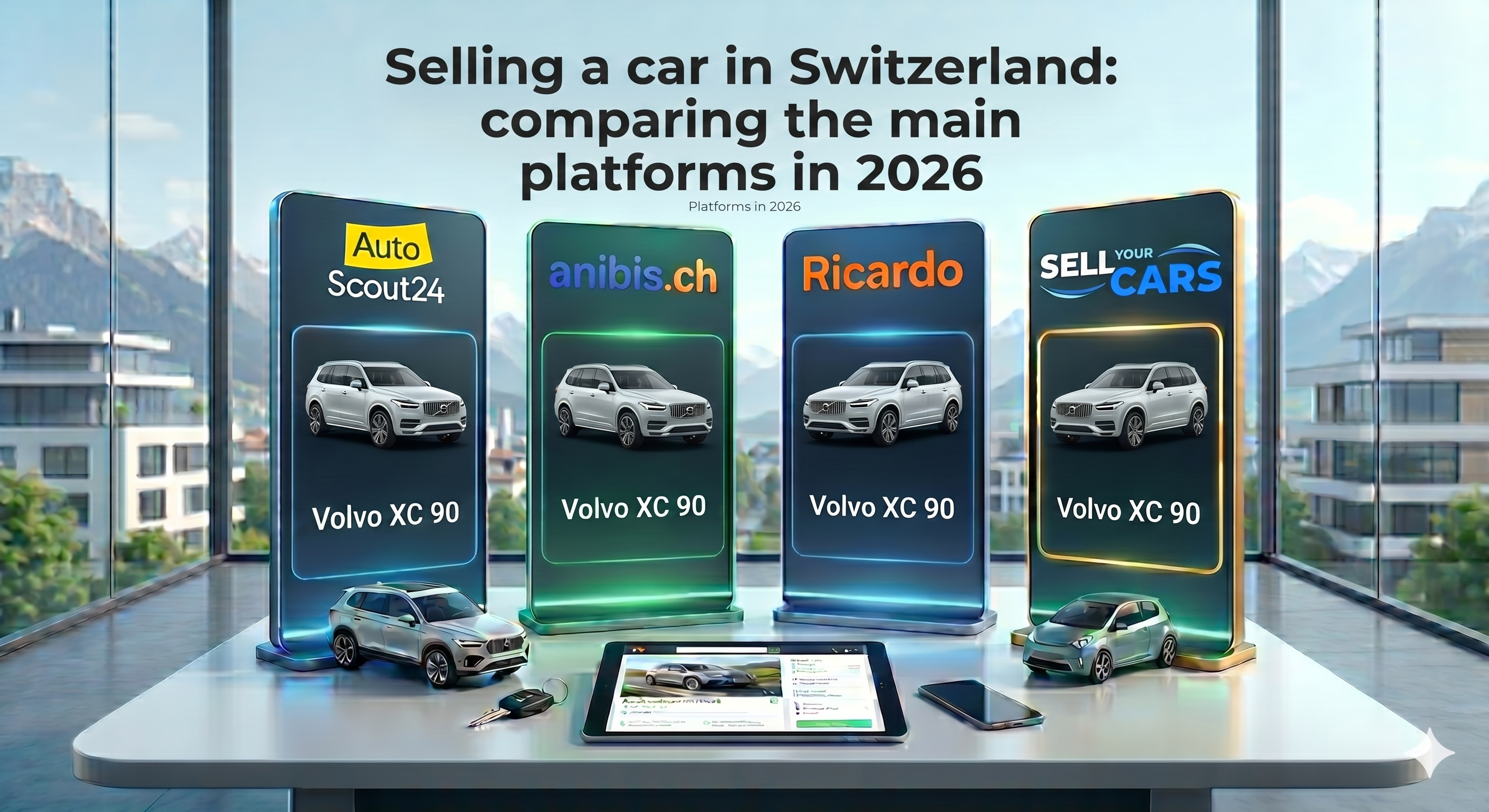
Reading time: 7 minutes. Updated on 29.04.2026.
28 April 2026
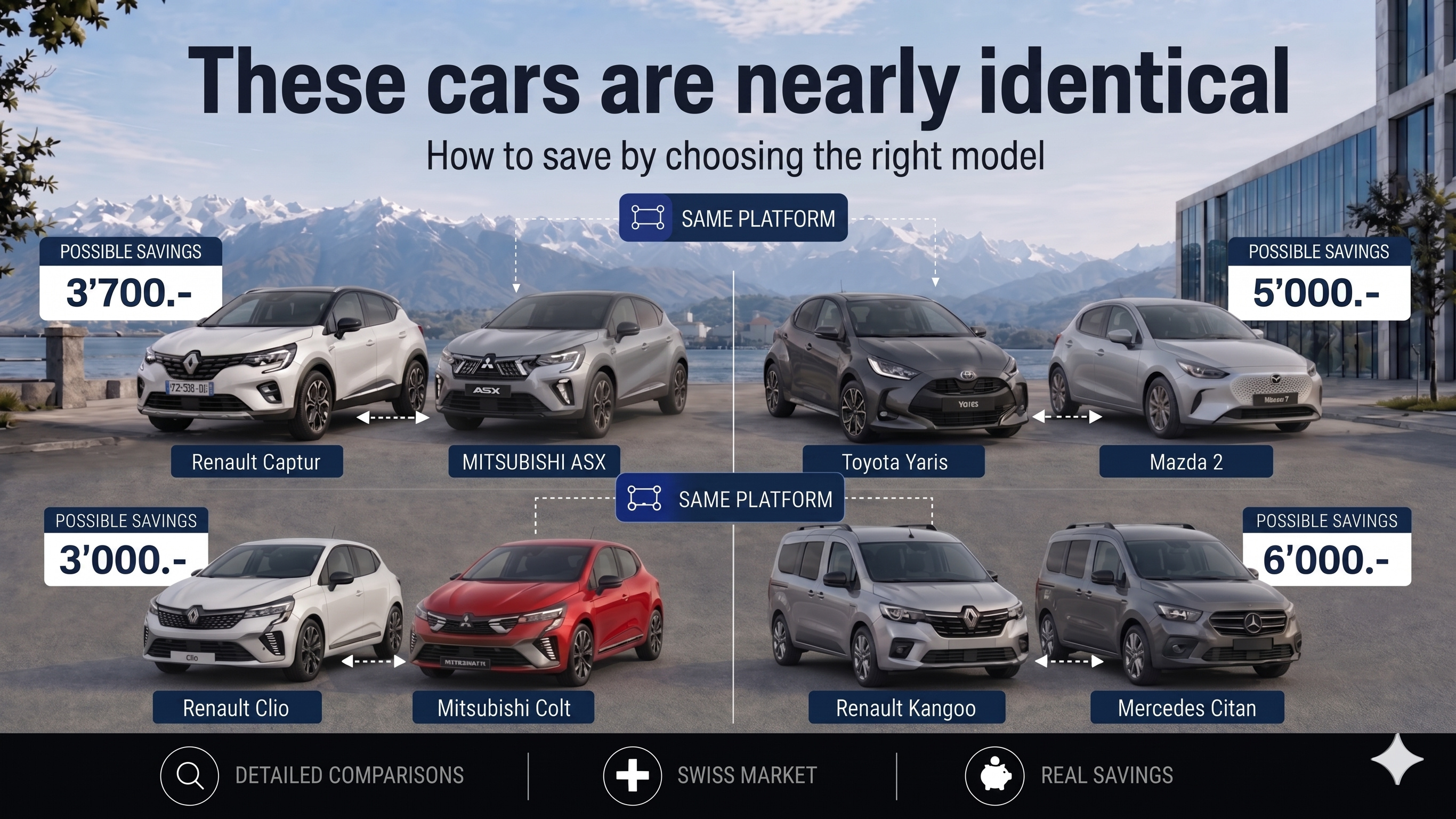
Reading time: 3 minutes. Updated on 28.04.2026 — comparison of identical vehicles in 2026.
16 April 2026
Reading time: 3 minutes. Updated on 16.04.2026 with the WLTP range calculation for 2026